A position statement by Helene Brembeck and Niklas Sörum presented to the CHIME project team meeting, Amsterdam Conservatory, February 4 2016
In WP 2 we want to question the idea that cultural heritage is about the past, and preservation. Instead we see cultural heritage as a practice, which is not simply about the past, but also about the future: it is about valuing the past and about preserving for the future and for future generations. Jazz today can thus be regarded as residing in a past-present relation: it is about selecting what is considered worth saving and of finding new modern and attractive techniques of communicating for the present and of assembling for the future. This view of cultural heritage is in line with the “New heritage paradigm” (Holtorf and Fairclogh 2013) that acknowledges that heritage is neither ‘fixed’ nor ‘ inherent’ but emerges in dialogue among individuals, communities, practices, places and things.
 Heritage, or ‘heritages’, are always also plural, which means that different, sometimes conflicting futures can be assembled. This becomes obvious in the ‘competition’ between our two studied festivals in Gothenburg – Gamlestaden Jazz and Classic Jazz - of which ‘jazz past’ is to be saved and enacted in the present and assembled for the future. We follow Rodney Harrison (2013, 2015) stating that ‘heritage involves working with the tangible and intangible traces of the past to both materially and discursively remake both ourselves and the world in the present, in anticipation of an outcome that will help constitute a specific (social, economic, or ecological) resource in and for the future (Harrison 2015:35).
 Harrison is inspired by neo-materialist thinkers, such as Deleuze and Latour and their aim to bridge divides between nature and culture, humans and non-humans, which means breaking the divide between tangible and intangible heritage: obviously jazz as intangible heritage is also very tangible, embodied and object-based.
Harrison bases his theses on what he names “connectivity ontologies” meaning ‘modalities of becoming in which life and place combine to bind time and living beings into generations of continuities that work collaboratively to keep past alive in the present and for the future’ (2015:27). This means that heritage can be seen as collaborative, dialogical and interactive, a material-discursive process in which past and future arise out of dialogue and encounter between multiple embodied subjects in (and with) the past (ibid.). Referring to Latour (2004), in this process, or what is described as a nature-culture assemblage, not only humans but also objects (music instruments, our comment) and practices (playing, dancing, our comment) have ‘rights’, which we may have obligations to attempt to uphold.
Harrison uses the term ‘domain’ to draw attention to the tendency for different fields of heritage practice to operate relatively autonomously, with each of these domains specifying particular objects of conservation and accompanying methods of management. Different heritage ontologies have different future-making capacities. Jazz can thus be considered as one such domain where a multiplicity of forms of existence are enacted in concrete practices, and ‘where politics becomes the elicitation of this manifold of potential for how things could be.’ (2015:34). This means that heritages can be defined as ‘a series of diplomatic properties that emerges in dialogue of heterogeneous human and non-human actors who are engaged in keeping pasts alive in the present and, which function towards assembling futures.’ (2015:28)
What about the jazz festival? Following Harrison the jazz festival can be regarded as an assemblage, a set of practices, or even ‘machine’ for ‘enacting new realities through contingent processes of assembling and reassembling bodies, technologies, materials, values, temporalities and meanings’ (2015:28). Practices specifically dealing with heritage-making across diverse contexts can be characterized as:
- Categorizing (identifying, documenting, nominating, listing, recovering, enumerating)
- Curating (collecting, selecting, attributing value)
- Conserving (caring, preserving, storing, archiving, managing)
- Communicating (using, interpreting, exhibiting)
All of which can be witnessed in the practices of assembling the jazz festivals, and most obviously, practices of communicating.
From these starting points the following research questions can be posed:
- Where and how are pasts given presence at the two jazz festivals?
- Which (jazz) pasts are envisioned?
- Whose cultural heritage in terms of gender, generation, social class and ethnicity?
- What are the networks that facilitate these processes?
- What temporalities are produced by the two festivals and what are the implications of the different modes of engagement with the past, present and future that are generated at the two festivals?
More specifically in relation to marketisation:
- How are aspects of cultural heritage explicitly or implicitly used in marketing, organization and enactment of the festivals?
- How does cultural heritage become important in constructing a market for the festivals in relation to for example profit, pricing, sponsors, competition, use of social media and communicating with visitors?
References
Harrison, Rodney. 2015. Beyond “Natural and “Cultural” Heritage: Toward an Ontological Politics of Heritage in the Age of the Anthropocene. Heritage & Society, Vol. 8 No 1, May, 24-42.
Harrison, Rodney. 2013. Heritage: Critical Approaches. Routledge: Abingdon and N.Y.
Holtorf, Cornelius and Graham Fairclough. 2013. The New Heritage and the re-shapings of the past. In Reclaiming Archaeology: Beyond the Tropes of Modernity, edited by Alfredo González-Ruibal, pp. 197-2010. Routledge: Abingdon and New York.
Latour, Bruno. 2004. Politics of Nature. Cambridge, Mass: Harvard University Press.



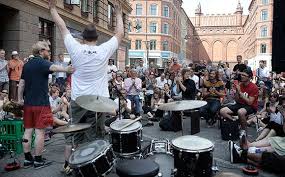 The relationship between jazz, festivals, and heritage sites is a complex and underexplored field of enquiry. Since the late 1940s, jazz and improvised music festivals have developed synergetic relationships with heritage sites to the point where, in different European settings today, festivals employ and engage with a range of heritage forms. Festivals facilitate uses and re-uses of heritage and have a transformative impact on attitudes to place, identity and history, from events that draw on landscapes, stately homes, iconic buildings and sites of historic importance to performance projects that encourage new forms of engagement and participation.